
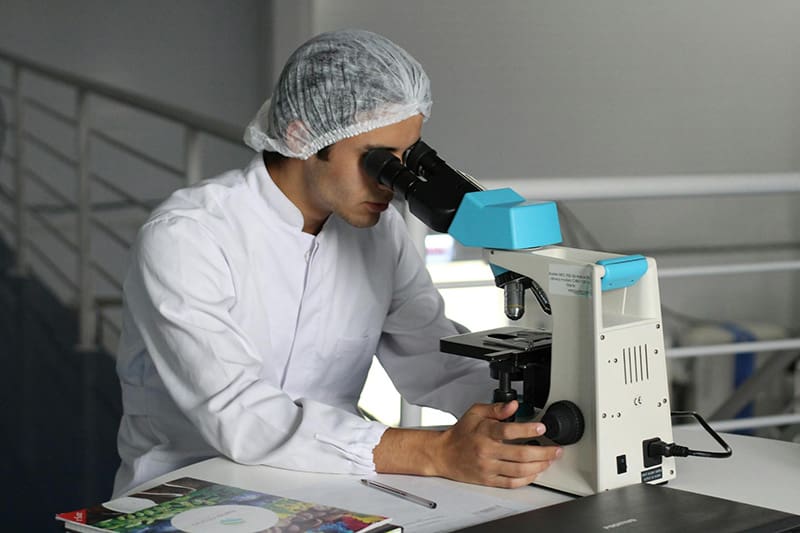
Your eggs, sperm, and embryos spend some of the most important hours of in vitro fertilization (IVF) in the lab, and you’ll rarely see it.
Here are nine features worth looking for, and how our labs meet each one. We have been helping Florida families grow for 40 years and counting, and our labs in Margate and Jacksonville serve patients from every location. Kathleen Miller, D.H. Sc., oversees all embryology and andrology operations at IVF Florida.
1. Specialized labs for each part of your care
A full-service fertility practice relies on more than one lab. We run specialized labs, and all follow the same rigorous, verified protocols.
Lab | What happens there | What it means for you |
Embryology | Egg and embryo culture, selection, and freezing | A steady, consistent environment for your developing embryos |
Andrology | Semen analysis, sperm washing and freezing, and donor sperm preparation | Strict identity checks on every sample |
2. Two-person identity checks at every stage
A strong lab verifies the identity of every specimen at every step. Two embryologists confirm the identity of samples at each stage, for example, making sure the correct sperm is paired with the correct eggs.
You’re part of the process too. We’ll ask you to confirm your identity out loud at several points during treatment.
3. Electronic witnessing that tracks every step
Human checks work best alongside electronic ones. We use RI Witness, an electronic witnessing system that links every sperm sample, egg, embryo, and dish to the right patient.
RI Witness creates a detailed, time-stamped log of each step and flags any possibility of a mismatch before one can occur.
4. Carefully controlled air quality
Embryo development is sensitive to its surroundings, and research has linked poor air quality in IVF labs with lower fertilization and embryo development rates.
Our IVF labs use HEPA filtration that removes both airborne particles and gases known as volatile organic compounds (VOCs). Humidity is held at precise levels throughout the lab, too.
5. A private incubator space for your embryos
Early embryos benefit from a stable environment with as few disruptions as possible. In older lab setups, several patients’ embryos often shared incubator space, so opening it for one patient changed conditions for everyone’s.
Each patient’s embryos develop in an isolated incubator space. It’s opened only for that patient’s assessments and procedures.
6. Time-lapse embryo monitoring
Ask whether a lab uses time-lapse imaging. In a traditional incubator, embryologists have to take embryos out to check on them, so assessments are limited to brief snapshots, usually about once a day.
Our embryology labs use EmbryoScope™ time-lapse incubators. Each one has a built-in microscope and camera that photograph your embryos every 10 minutes, so our embryologists can follow their development without removing them from the incubator.
Those images become a time-lapse video of each embryo’s growth. Our embryologists review the videos, along with software analysis, when deciding which embryos to transfer or freeze.
7. Accreditation and public outcome reporting
Our labs are accredited by the College of American Pathologists, an independent, nonprofit organization whose accreditation is recognized nationwide as a mark of quality.
Our embryology labs also meet the stringent criteria required for membership in the Society for Assisted Reproductive Technology (SART), the organization that sets standards for assisted reproductive technology (ART) care in the U.S. We report birth outcome data to SART every year, so our results are available for anyone to review.
8. Embryologists with years of training
Embryology is highly specialized work. Our embryologists complete rigorous training pathways of mentorship and supervised practice. Competency is verified annually.
9. Research that moves fertility care forward
Practices that contribute to research tend to stay close to the latest evidence. Every year, our physicians and scientists contribute research to the American Society for Reproductive Medicine (ASRM) annual meeting and publish in leading journals, including Fertility and Sterility and Human Reproduction.
Questions to ask about any IVF lab
What does an IVF lab do?
An IVF lab handles the steps of treatment that happen outside the body: fertilizing eggs, growing embryos, freezing eggs, sperm, and embryos, and preparing embryos for transfer. Many practices also run andrology and endocrine labs for semen analysis, sperm preparation, and hormone testing.
How do IVF labs prevent mix-ups?
High-quality labs use a chain-of-custody protocol that combines human and electronic checks. At IVF Florida, two embryologists confirm identity at each stage, patients confirm their identity out loud at key points, and an electronic witnessing system logs every step.
What is an EmbryoScope?
An EmbryoScope is a time-lapse incubator with a built-in microscope and camera. It photographs embryos every 10 minutes, so embryologists can watch them develop without taking them out of the incubator.
What accreditation should an IVF lab have?
Look for lab accreditation from an independent organization, such as the College of American Pathologists (CAP), and SART membership for the embryology lab. SART members report their outcomes every year, which lets you review a practice’s results.
Can I learn more about the lab during my consultation?
Yes. Bring your questions to your first visit. Our team is happy to explain how your eggs, sperm, and embryos are cared for in the lab.
See the labs behind your care
Want to learn more about IVF Florida’s labs or talk with a fertility specialist? Call 954-247-6200 or request an appointment online.